For the last two years, most conversations around LLM security have revolved around jailbreaks.
Researchers publish new prompts. Social media shares screenshots. Vendors patch specific attacks. New bypasses emerge days later.
The result is a widespread misconception:
People think AI security is fundamentally a prompting problem.
It isn't.
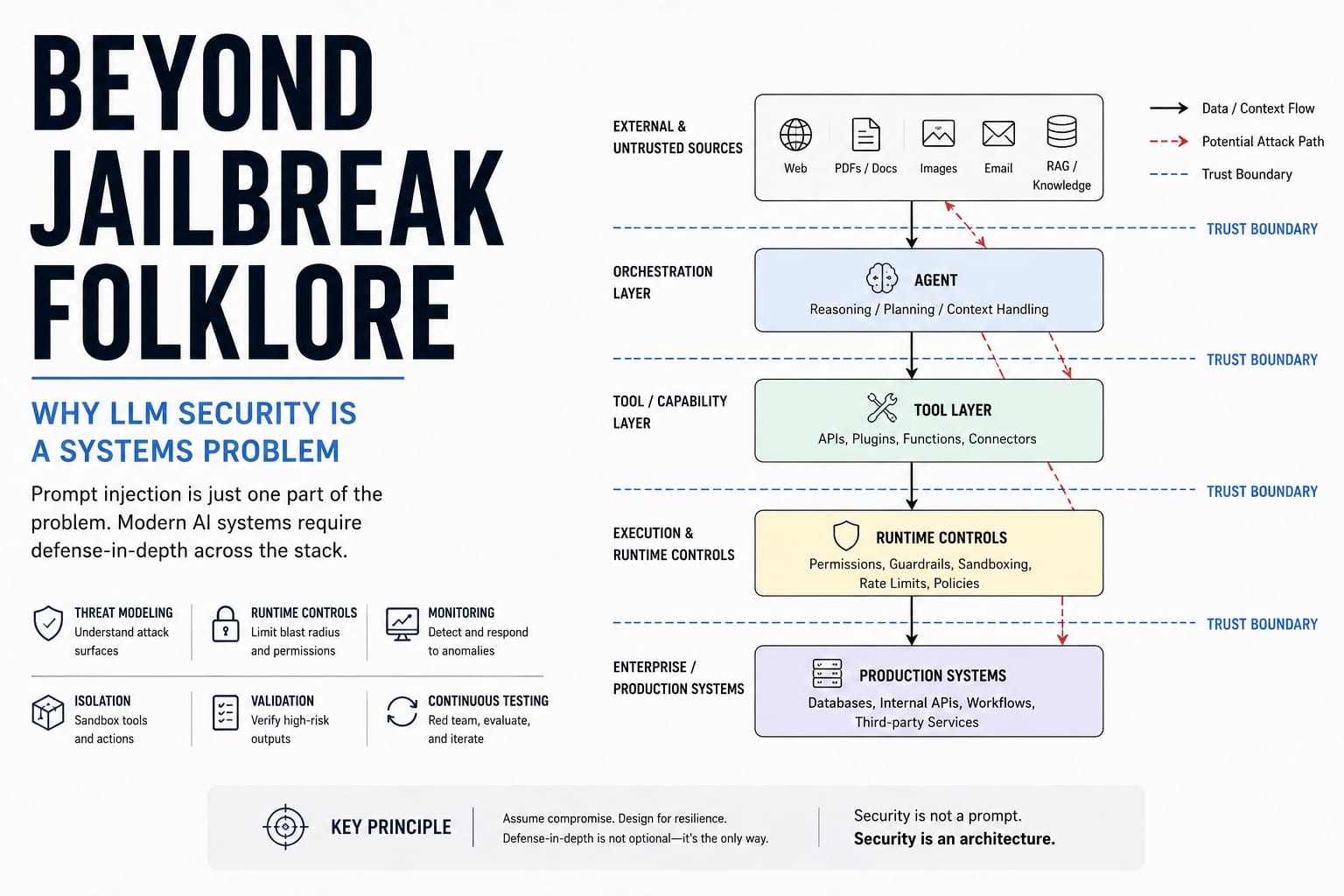
Modern AI security is increasingly a systems engineering challenge involving trust boundaries, tool permissions, runtime isolation, external data sources, retrieval pipelines, multimodal inputs, model alignment, and operational controls.
The industry's obsession with prompts often distracts from the more important question:
What happens after a model is manipulated?
The Failure of Prompt-Centric Security
Traditional software security benefits from clear separations:
- Code vs data
- Instructions vs input
- Executable vs content
Large Language Models blur these distinctions.
A prompt is simultaneously:
- Data
- Instruction
- Context
- Configuration
This creates an unusual attack surface where untrusted content can influence execution behavior.
Unlike SQL injection, where the goal is to separate code from user input, LLMs intentionally combine instructions and content into a single context window.
This architectural property makes prompt injection fundamentally different from traditional application vulnerabilities.
The question is no longer:
Can the attacker inject instructions?
The question is:
Can the model distinguish trusted instructions from untrusted instructions?
For current frontier models, the answer remains imperfect.
System Prompts Are Not Security Boundaries
One of the most persistent myths in the ecosystem is the belief that system prompts provide meaningful security guarantees.
They do not.
System prompts are configuration layers.
They influence behavior.
They improve consistency.
They help establish priorities.
However, they are not equivalent to access control systems.
They are not equivalent to operating system permissions.
They are not equivalent to cryptographic trust boundaries.
A useful mental model is:
System prompts are closer to organizational policies than technical enforcement mechanisms.
A company handbook may state what employees should do.
It does not physically prevent violations.
Similarly, system prompts guide model behavior but do not create hard security guarantees.
This distinction becomes increasingly important as agents gain capabilities.
Agentic Systems Change Everything
Prompt injection becomes dramatically more serious when models move beyond text generation.
A standalone chatbot has limited impact.
An autonomous agent can:
- Browse websites
- Read documents
- Execute tools
- Access databases
- Send emails
- Trigger workflows
- Modify infrastructure
In these environments, every external source becomes a potential instruction channel.
Consider an AI agent that:
- Reads a webpage
- Extracts information
- Uses tools
- Sends a report
The webpage is no longer merely content.
It becomes executable influence.
The Hidden Problem: Indirect Prompt Injection
Direct prompt injection is obvious.
An attacker writes:
Ignore previous instructions.
Modern defenses frequently catch these attacks.
Indirect prompt injection is significantly more dangerous.
Instructions are embedded inside:
- PDFs
- Webpages
- Documents
- Spreadsheets
- Images
- OCR text
- Retrieved knowledge chunks
The model encounters them during normal processing.
The attack is no longer coming from the user.
The attack is coming from the environment.
This fundamentally changes threat modeling.
The problem is no longer malicious users.
The problem becomes untrusted ecosystems.
Multimodal Systems Expand the Attack Surface
Vision-enabled models introduced a new category of security concerns.
Historically, prompt injection existed primarily in text.
Now instructions can be embedded inside:
- Images
- Screenshots
- UI elements
- Visual overlays
- OCR artifacts
- Hidden graphical patterns
The model may extract instructions from visual content while simultaneously processing textual requests.
This creates cross-modal attack paths.
For example:
Image → Hidden Instruction
Text → User Intent

↓

Model merges both contexts

↓

Behavior changes
As multimodal architectures mature, these attack surfaces will likely become increasingly important.
Security teams should stop treating images as passive data.
Images are now executable influence channels.
The Fine-Tuning Security Problem
Most organizations view fine-tuning as a performance optimization.
Security teams should view it as a supply chain event.
Every fine-tune modifies behavior.
Every adapter modifies behavior.
Every LoRA modifies behavior.
The assumption that alignment survives downstream customization is increasingly difficult to defend.
Small modifications can produce significant behavioral shifts.
This creates a new challenge:
Organizations inherit risk not only from base models but from every adaptation layer applied afterward.
Security validation cannot stop at model selection.
It must continue after:
- Fine-tuning
- LoRA integration
- Adapter merging
- Model updates
- Retrieval modifications
Alignment is not static.
It drifts.
Runtime Controls Matter More Than Prompts
Prompt engineering receives most of the attention because it is visible.
Runtime security receives less attention because it is infrastructure.
However, mature AI systems increasingly rely on runtime controls:
Isolation
Contain actions.
Limit blast radius.
Assume compromise.
Permission Boundaries
Models should not automatically receive unrestricted access to tools.
Capabilities should be explicitly scoped.
Monitoring
Observe:
- Tool usage
- Retrieval behavior
- Context construction
- Output anomalies
Verification Layers
High-impact actions require secondary validation.
Sandboxing
Actions execute inside controlled environments rather than production systems.
These controls do not prevent compromise.
They reduce consequences.
That distinction is critical.
Defense in Depth for LLM Systems
The future of AI security resembles mature cloud security more than prompt engineering.
Organizations should think in layers:
Layer 1: Model Alignment
Reduce harmful behavior.
Layer 2: Input Inspection
Analyze incoming content.
Layer 3: Context Construction
Control retrieval pipelines.
Layer 4: Tool Governance
Limit capabilities.
Layer 5: Runtime Monitoring
Detect abnormal behavior.
Layer 6: Output Validation
Verify critical actions.
Layer 7: Isolation
Contain failures.
No single layer is sufficient.
Collectively they create resilience.
The Most Important Mindset Shift
The biggest mistake teams make is asking:
How do we stop jailbreaks?
The better question is:
How do we remain secure when jailbreaks happen?
This mindset mirrors mature cybersecurity practices.
Organizations do not assume:
- Networks are impossible to breach.
- Users never click malicious links.
- Vulnerabilities never exist.
They assume failure and design accordingly.
AI systems require the same philosophy.
Security should not depend on perfect model behavior.
Security should depend on resilient system design.
Conclusion
The future of LLM security will not be determined by better prompts.
It will be determined by better architectures.
Prompt injection is not disappearing.
Multimodal systems are increasing complexity.
Agentic workflows are expanding capability.
Fine-tuning is creating new supply-chain risks.
The winning organizations will not be those with the cleverest jailbreak defenses.
They will be the organizations that understand a simple principle:
Models are intelligent. Systems must be resilient.